Fruit, Fiber, and Fire by William R. Carleton
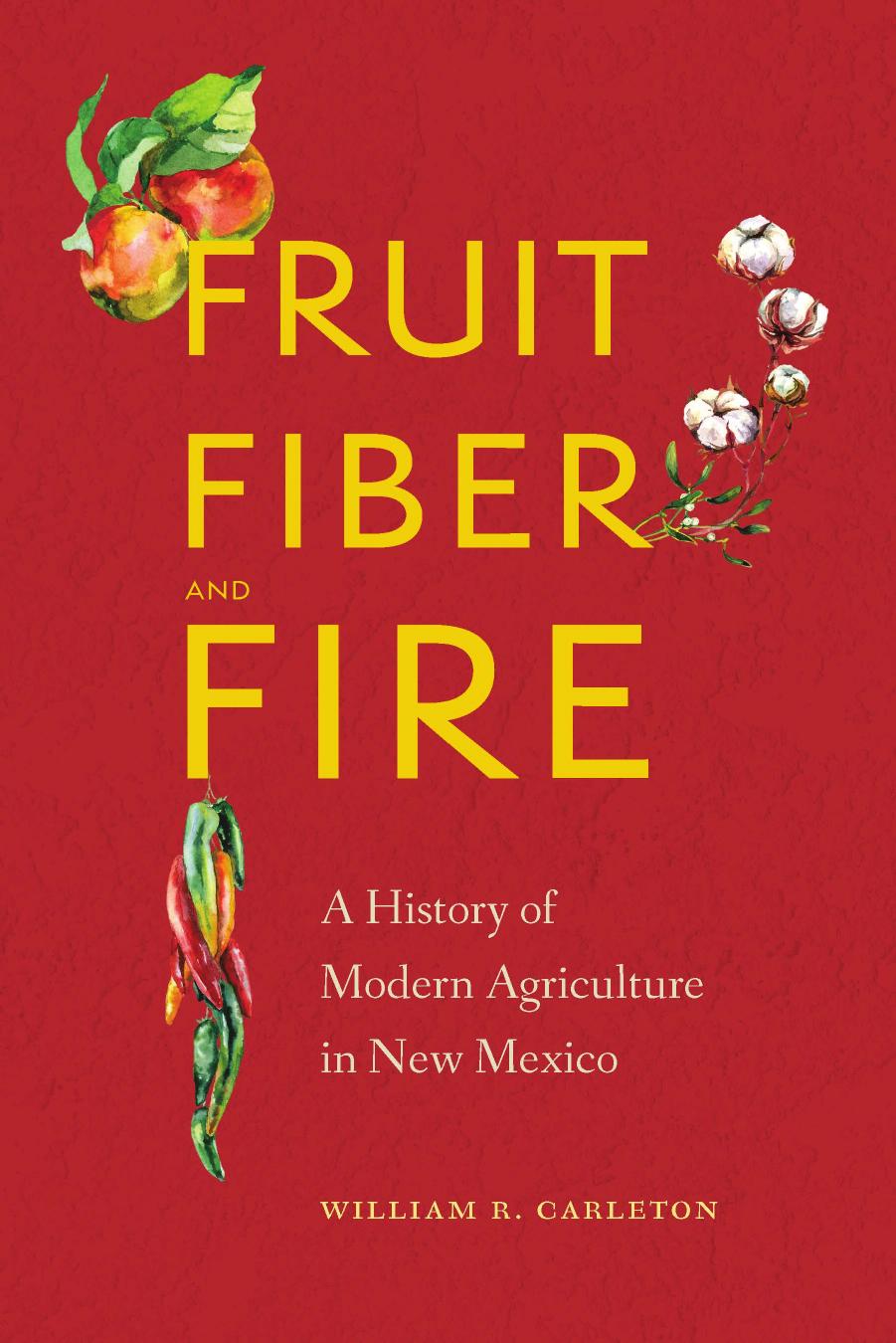
Author:William R. Carleton [Carleton, William R.]
Language: eng
Format: epub, pdf
Part 3
Chile
5
Crossing Chiles, Crossing Borders
Dr. Fabián GarcÃa, the New Mexican Chile Pepper, and Modernity in the Early Twentieth-Century U.S.-Mexico Borderlands
New Mexicoâs official state questionââRed or green?ââinquires tongue-in-cheek about chile preference to celebrate one of the stateâs leading crops and economic engines. Implicitly the question also signals pride for New Mexicoâs Hispanic and Native cultural heritage. This official display of pride came roughly a century after New Mexican politicians and other territorial elites debated, in explicitly racist terms, whether New Mexico was modern and white enough to become fully incorporated into the union.1 As these elites sought to distance New Mexicoâs population from its indigenous heritage and its neighbors to the south, a Mexican-born horticulturalist at New Mexicoâs land-grant college, Dr. Fabián GarcÃa, bred a new chile variety that embodied an alternative vision of modernity for New Mexico. The new chile pepper encouraged a more industrialized, more culturally inclusive borderlands and set the course for an industry that would eventually define the stateâs cultural identity.
GarcÃa held an important position as a cultural and agricultural intermediary that shaped his work with the iconic chile. As horticulturalist at the New Mexico College of Agriculture and Mechanic Arts (NMAM), later New Mexico State University (NMSU), in Las Cruces, New Mexicoâpositioned more squarely in the borderlands than any other land-grant college in the United StatesâGarcÃa helped disseminate cultural and agricultural change in all directions in early twentieth-century New Mexico. The number 9 chile, as GarcÃa called the new variety, was more than simply the first scientific and industrial chile pepper; it embodied a pan-Hispanic and nationally inclusive vision for New Mexico that encouraged cultural transformations both within and beyond the borderlands. GarcÃaâs efforts transformed more than the chileâs genetics; his efforts represented the first major step in producing a modern crop that the nation as a whole could more readily consume. Perhaps better than any other single crop variety, the number 9 chile reveals the intersections among modernity, race, and nation within the wider economic and cultural network of the early twentieth-century U.S.-Mexico borderlands.
GarcÃa was âborn of humble parentsâ in 1871 in Chihuahua, Chihuahua. Two years after his parents died, his grandmother brought him to the mountains of southern New Mexico, where as a boy he recalled being terrified by encounters with Apaches. His grandmother eventually landed a job in Las Cruces with the prominent Casad family, who treated him âas a member of the family, in all respects,â sending him to grade school and then NMAM, which they had helped found. GarcÃa became a naturalized U.S. citizen in 1889, graduated from NMAMâs inaugural class of 1894, and shortly thereafter joined the faculty as a horticultural assistant. He worked on a wide range of projects at the college (particularly with fruit trees), spent a year doing graduate work at Cornell University in 1899â1900, and in 1907 married Julieta Amador, whose family had deep-rooted business and social connections with Mexico. His disparate experiences and connections from an early age cut across cultural, class, and geopolitical lines.2
When
Download
Fruit, Fiber, and Fire by William R. Carleton.pdf
This site does not store any files on its server. We only index and link to content provided by other sites. Please contact the content providers to delete copyright contents if any and email us, we'll remove relevant links or contents immediately.
Sapiens: A Brief History of Humankind by Yuval Noah Harari(14389)
The Tidewater Tales by John Barth(12659)
Mastermind: How to Think Like Sherlock Holmes by Maria Konnikova(7345)
The Thirst by Nesbo Jo(6944)
Do No Harm Stories of Life, Death and Brain Surgery by Henry Marsh(6941)
Why We Sleep: Unlocking the Power of Sleep and Dreams by Matthew Walker(6725)
Life 3.0: Being Human in the Age of Artificial Intelligence by Tegmark Max(5558)
Sapiens by Yuval Noah Harari(5370)
The Body: A Guide for Occupants by Bill Bryson(5096)
The Longevity Diet by Valter Longo(5064)
The Rules Do Not Apply by Ariel Levy(4969)
The Immortal Life of Henrietta Lacks by Rebecca Skloot(4587)
Animal Frequency by Melissa Alvarez(4470)
Why We Sleep by Matthew Walker(4445)
The Hacking of the American Mind by Robert H. Lustig(4382)
Yoga Anatomy by Kaminoff Leslie(4363)
All Creatures Great and Small by James Herriot(4321)
Double Down (Diary of a Wimpy Kid Book 11) by Jeff Kinney(4269)
Embedded Programming with Modern C++ Cookbook by Igor Viarheichyk(4179)
